
Skip to content

mdeg ConnectBox

The secure link between your device and the cloud

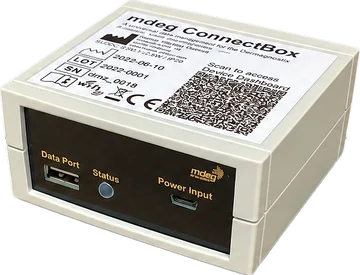
mdeg ConnectBox connects new and legacy medical and diagnostic devices to mdeg Cloud or your own infrastructure, as a plug-and-play unit, an embedded module or a software layer.

A medical device connects to the mdeg ConnectBox by wire (USB, UART, SPI, I2C) or wirelessly (BLE). The ConnectBox sends the data over Wi-Fi to the cloud.
  • ISO 27001 & 27701 certified
  • USB, UART, I2C, SPI & more
  • Connect legacy devices and existing fleets
  • From prototype to market

The connectivity layer you don’t have to build

Medical devices need more than a physical connection. They need a reliable, secure way to exchange data with the cloud without you developing and maintaining the connectivity layer yourself.

  • Wired or wireless, it grabs your dataThe ConnectBox connects to your device by cable via USB, UART, I2C or SPI, or wirelessly via Bluetooth and BLE. It grabs the relevant data and transmits it securely to the cloud, with limited changes to the device itself.
  • Built-in securityBuilt-in security helps protect your device data in transit, even over shared networks such as clinical guest Wi-Fi. Encrypted communication and mutual authentication establish a protected connection, with mdeg Cloud integration already in place.
  • One concept from prototype to productStart with an external unit for prototypes and pilots, then integrate the connectivity more deeply as your device evolves, without changing the way your data reaches the cloud.
  1. Medical device
  2. mdeg ConnectBox
  3. Secure cloud connection
  • mdeg Cloud
  • Customer cloud

Is the ConnectBox right for you?

It is ideally suited for:

  • Medical and diagnostic devices that need cloud connectivity
  • Existing devices that need a flexible connectivity interface
  • Prototype, clinical pilot and early market deployments
  • Home, hospital, laboratory and point-of-care environments
  • Products that need secure, structured device-to-cloud data transfer
  • Manufacturers who want to reduce in-house connectivity development
  • Projects that may evolve towards deeper device integration

Typical users: Medical device manufacturers, diagnostic companies and MedTech startups developing connected products for home, hospital, laboratory or point-of-care use.

Who works with it
The ConnectBox touches several teams in your organization. We work with all of them:
  • Product management
  • R&D and systems engineering
  • Service teams
  • Quality and regulatory

Core capabilities

Everything your device needs to exchange data with the cloud securely and reliably.

Device connectivity

Connect medical and diagnostic devices to mdeg Cloud or your own infrastructure through configurable interfaces such as USB, UART, I2C and SPI.

Plug-and-play integration

Add cloud connectivity to existing devices through structured data input and a ready-to-use connectivity layer.

Secure data transfer

Protected communication using MQTTS, HTTPS and certificate-based security, from the device to the cloud.

Data buffering & preprocessing

Data is buffered and preprocessed locally, so transmission stays reliable during temporary connection interruptions.

Remote maintenance

Remote configuration and OTA updates for connected devices, where included in the selected product configuration.

Reliable in any setting

In hospitals, laboratories, at the point of care or at home, with fallback between networks for maximum reliability.
  1. Medical device
  2. mdeg ConnectBox
  3. Secure cloud connection
  4. mdeg Cloud
  • Remote maintenance
  • Remote analysis
  • Video-assisted service & training

Customer example

Medical laboratory

From medical and diagnostic devices to secure cloud integration.

Tell us about your device and its interfaces, and we’ll show you the best-fit variant.

Discuss your device connectivity

Three ways to integrate

Move from external connectivity to deeper integration as your product evolves.

External ConnectBox

Ready to use, limited device changes.

A ready-to-use connectivity unit for existing devices, suited for prototypes, clinical pilots and early market deployments.

Embedded module

For the next device generation.

The connectivity function is integrated more deeply into your device, for compact, product-specific designs with the same secure data path.

ConnectOS software layer

Connectivity in your own architecture.

The technology runs as a software layer on your hardware: the highest level of integration, adapted to your operating environment.

Depending on the selected configuration and project scope, the ConnectBox communicates with mdeg Cloud or a customer cloud environment via the available secure interfaces.

How we connect your device

A fast, modular process matched to your development phase, whether you are building a prototype or scaling a market-ready device.

  1. Select the configuration

    We help you choose the best-fit variant based on your device, interfaces and product stage: external unit, embedded module or ConnectOS.

  2. Integrate & test

    You get pre-configured hardware and built-in connectivity. We set up the cloud link and make sure everything works from day one.

  3. Launch & scale

    We take care of updates and support, so your team can focus on the product, not the connectivity.

What mdeg ConnectBox enables

Connect your devices with less development effort and keep one connectivity concept from prototype to market.

  • Connect devices to the cloud with less development effort
  • Use one connectivity concept from prototype to market deployment
  • Establish secure and controlled device-to-cloud communication
  • Buffer data during temporary connection interruptions
  • Support remote configuration and OTA updates, where included
  • Move from external connectivity to deeper integration as the product evolves

Secure by design

Security, data protection and compliance are considered from the beginning, from the device interface to the cloud.

Data leaves the medical device through the ConnectBox and travels via MQTTS or HTTPS with certificate-based security to mdeg Cloud, certified under ISO 27001 and ISO 27701. An untrusted endpoint is blocked by mutual authentication.
Data leaves your device through protected channels: MQTTS and HTTPS with certificate-based security. Connected to mdeg Cloud, it is processed in a certified information security management system (ISO 27001) and privacy information management system (ISO 27701).

Documentation in line with ISO 13485 and IEC 62304 is scoped to your product, project phase and regulatory context, so the ConnectBox fits into your technical documentation.

Frequently asked questions

Answers to the most common questions about our connectivity solution.

All questions
Do we need to build any infrastructure ourselves?
No. mdeg delivers the ConnectBox, the cloud connection and, with mdeg Cloud, hosting and operation. You choose the configuration, we take care of the rest.
Can we use our own cloud?
Yes. Depending on the selected configuration and project scope, the ConnectBox communicates with mdeg Cloud or a customer-managed cloud environment via the available secure interfaces (MQTTS, HTTPS).
Which devices and interfaces does it support?
Active medical and diagnostic devices, new products as well as legacy devices. The ConnectBox connects via USB, UART, I2C, SPI, serial, BLE and other interfaces, in home, hospital, laboratory and point-of-care environments.
How long does integration take?
It depends on the device and its interfaces. If you want to validate the use case first, the mdeg Starter Kit combines a ConnectBox with a pre-configured cloud and initial visualization.
What happens if the connection drops?
The ConnectBox buffers and preprocesses data locally and transmits it once the connection is back, so transmission stays reliable during temporary interruptions.
Can we update devices remotely?
Remote configuration and OTA updates are supported where they are included in the selected product configuration. We define this together with you when choosing the variant.

One connectivity concept from prototype to market

Let’s discuss your device, its interfaces and where it will be used.